







Cookies help us deliver our services. By using our services, you agree to our use of cookies.



AYWHP
AYWHP
Displayper page
Sort by
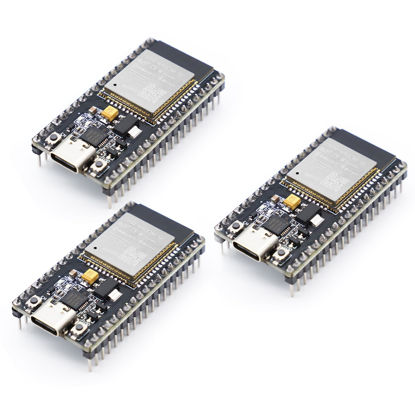
ESP32 Development Board AYWHP 3 Pcs ESP32 ESP-WROOM-32 Module with CP2012 Chip WiFi+Bluetooth Dual Core Support STA/AP/STA+AP Type-C Interface 38 PINS Soldered Version Compatible with Arduino
【ESP32 WiFi and Bluetooth Module】: Features the powerful ESP-WROOM-32 ESP32 chip with dual-mode Bluetooth and WiFi capabilities, perfect for IoT applications. | 【CP2012 USB to Serial Communication】: ESP32 wroom equipped with CP2012 USB-to-serial chip for easy communication with various microcontrollers and computers, Compatible with Arduino. | 【Supports Lua Programming】: The ESP32 board supports Lua scripting language, which simplifies the development process and makes it more accessible for both beginners and advanced users. | 【Compact and Versatile Design】: The compact size allows easy integration into any project,esp32 usb c supports AP, STA, and AP+STA coexistence modes. | 【Reliable Performance】: Built using TSMC 40nm low-power technology, the ESP32S offers high performance with minimal power consumption.
₹1,871.07
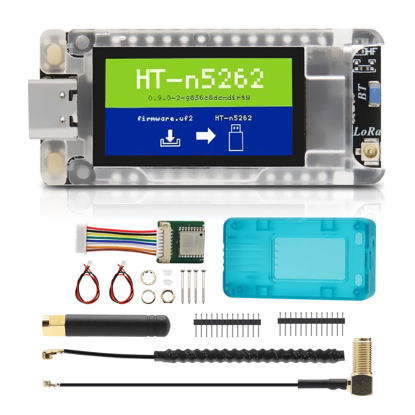
Mesh Node T114 V2 LoRaWAN Meshtastic Board AYWHP Meshtastic Tracker Nordic nRF52480 with Screen GNSS + Screen Case 1.9″ TFT Display 902-928MHz SX1262 Chip BLE WiFi Compatible with Arduino/Meshtastic
High Compatibility: Compatible with Meshtastic and Arduino, this mesh node T114 V2 development board uses the powerful LoRaWAN SX1262 chip for long-range communication. Perfect for low-power applications. | Power Efficiency: With deep sleep current as low as 11uA, this mesh node T114 V2 board is designed for optimal power efficiency, making it ideal for battery and solar-powered projects. | Multiple Interfaces: Equipped with USB 2.0, LiPo battery connectors (21.25mm), solar panel connectors (21.25mm), and GNSS module connectors (81.25mm), offering strong expandability and compatibility. | Easy to Connect: Simple plug-and-play GNSS connectors allow for fast and easy connections and disconnections, enhancing the versatility of your project setups. | Versatile Display: Features a 1.14" high-resolution TFT-LCD display (optional), offering clear visuals with a 135(H)RGBx240(V) resolution and 262K colors.
₹6,065.37
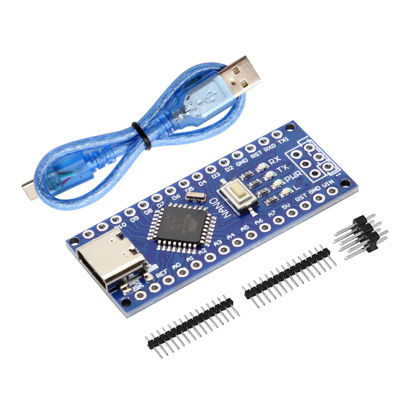
Nano V3.0 Board with Cable, AYWHP 1PCS Nano Board ATmega328P, CH340G Chip 5V 16M, Microcontroller Compatible with Arduino Nano (USB C Port)
The Nano is using the chips ATmega328P and CH340, not FT232 as official Arduino. It works just like the original Nano board and is very cost-effective for beginners. | Uses atmega328p-AU as MCU, support ISP download; Support USB download and power supply. Compatible with Arduino Nano, fully compatible with Windows, Mac and Linux operating systems. | The Nano board can be powered via a USB C connection; 6-12 V unregulated external power supply or 5 V regulated external power supply. The Nano automatically detects and switches to the power source with higher potential, no power selection jumper is required. | The Nano board has 14 digital I/O pins (6 of which can be used as PWM outputs), 6 analogue inputs, a 16MHz quartz oscillator, a USB C power socket, an ICSP port and a reset button. | The Nano board has numerous possibilities for communication with a PC or other microcontrollers and is fully compatible with the operating systems Windows, Mac and Linux. This board is particularly breadboard friendly and the connections are very easy to handle.
₹1,257.27
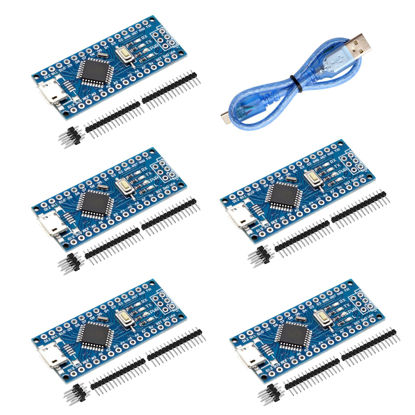
Nano V3.0 Board with Cable, AYWHP 5PCS Nano Board ATmega328P, CH340G Chip 5V 16M, Microcontroller Compatible with Arduino Nano (Micro USB Port)
The Nano is using the chips ATmega+328P and CH340, not FT232 as official Arduino. It works just like the original Nano board and is very cost-effective for beginners. | Uses atmega328p-AU as MCU, support ISP download; Support USB download and power supply. Compatible with Arduino Nano, fully compatible with Windows, Mac and Linux operating systems. | The Nano board can be powered via a Micro USB connection; 6-12 V unregulated external power supply or 5 V regulated external power supply. The Nano automatically detects and switches to the power source with higher potential, no power selection jumper is required. | The Nano board has 14 digital I/O pins (6 of which can be used as PWM outputs), 6 analogue inputs, a 16MHz quartz oscillator, a Micro USB power socket, an ICSP port and a reset button. | The Nano board has numerous possibilities for communication with a PC or other microcontrollers and is fully compatible with the operating systems Windows, Mac and Linux. This board is particularly breadboard friendly and the connections are very easy to handle.
₹2,177.97
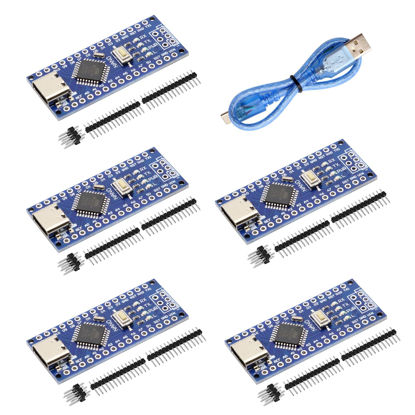
Nano V3.0 Board with Cable, AYWHP 5PCS Nano Board ATmega328P, CH340G Chip 5V 16M, Microcontroller Compatible with Arduino Nano (USB C Port)
The Nano is using the chips ATmega328P and CH340, not FT232 as official Arduino. It works just like the original Nano board and is very cost-effective for beginners. | Uses atmega328p-AU as MCU, support ISP download; Support USB download and power supply. Compatible with Arduino Nano, fully compatible with Windows, Mac and Linux operating systems. | The Nano board can be powered via a USB C connection; 6-12 V unregulated external power supply or 5 V regulated external power supply. The Nano automatically detects and switches to the power source with higher potential, no power selection jumper is required. | The Nano board has 14 digital I/O pins (6 of which can be used as PWM outputs), 6 analogue inputs, a 16MHz quartz oscillator, a USB C power socket, an ICSP port and a reset button. | The Nano board has numerous possibilities for communication with a PC or other microcontrollers and is fully compatible with the operating systems Windows, Mac and Linux. This board is particularly breadboard friendly and the connections are very easy to handle.
₹2,280.27
About us

Shop From Catalogue Of USA Bestsellers
Many times, we want to purchase products from USA simply because they are not available in India or the cost might be high. Generally, we think that the process of delivering the products from USA to India would be very expensive and complicated. But, now, you won't be disappointed, GetUSCart is here for you. Here, you can shop from catalogue of USA bestsellers.
Fast Shipping From USA To India - 7 To 10 Working Days
Are you in thought of shipping USA products to India will take much time? If your answer is yes, it’s absolutely not correct. GetUSCart is behind you to provide fast shipping from USA to India - 7 to 10 working days. GetUSCart is behind you to provide fast shipping from USA to India - 7 to 10 working days. Shop with GetUSCart and get shipped all your favorite products quickly from USA to India.


Low Shipping Cost From USA To India
You don't think about the shipping cost when you are buying USA products at GetUSCart. Literally, you will surprise when you see the shipping price on your ordered products. You can save more money with our low shipping cost from USA to India. Get all our products including beauty & personal care products, office products, toys, electronics and many others with less shipping charges.
No Hassles Of Custom Clearance In India
When items ship from USA to India, they have to go through customs before they will be released for final delivery. So, GetUSCart is responsible for all this custom clearance procedure for our products. We will pay custom duties, fees, taxes and etc. GetUSCart delivers your product without any issues regarding custom clearance.

Get Delivered Your Favourite Product From USA To Doorsteps In India
If you like the United States products, shop at GetUSCart whatever you need. And, get it delivered from USA to your own home in India with no stress. Simply place an order of your favorite products through our GetUSCart website or app. We will ship and deliver them from USA to India.
Don't Find A Product In Our Catalogue. Request A Product Now!
Find products whatever you want in our catalogue. We have various categories of products such as Electronics, Clothing, Shoes & Jewelry, Arts, Crafts & Sewing, Office Products, Toys & Games, Baby Products, Devices & Accessories, Kitchen & Dining, Cameras, Patio, Lawn & Garden, Musical Instruments, Beauty & Personal Care, etc. If you didn’t find your favorite product, you can request us by entering that product details.

K M Enterprises
Suite 311, AKM Dharma Rao Signature
Madinaguda, Hyderabad - 500049
email: [email protected]
All major credit, debit cards, net banking, wallets accepted securely
